
I have an opinion that the Western (predominantly European and US) game development industry experiences a decline. The decline is both in the quality of products and in the share of profits as compared to the Asian or Eastern game development industry. Here I analyze a particular case of the game development studio “Tripwire Interactive, LLC” and their last product in their most lucrative intellectual property line, the game “Killing Floor III”. I identify the adherence to DEI (Diversity, Equity and Inclusion) policy as the biggest factor of the decline, whether these were followed deliberately or not, document the most important milestones in how it affected the game studio and provide specific recommendations on what needs to be done by the future game developers to avoid making similar mistakes.
The last installment in the “Killing Floor” franchise, produced by Tripwire Interactive, the Killing Floor III game, is a failed game. It also, coincidentally, not a Killing Floor game. It doesn’t adhere to many of the core game design principles that are distinguishing for Killing Floor games, setting them apart from other games. In this post I also attempt to identify these principles and quantify each KF game for the level of adherence to them. I also attempt to identify the people and the events that have led to this state of the game based on publicly available information and provide some reflection on these events.
Before I begin, I want to be upfront with the standpoint from which I analyze it. I am a white male hardcore first person shooter gamer. I’m a KF2 player with >5K hours in. I didn’t play as much the original retail KF and have only a few hours in it. I started playing KF2 after buying it with a discount during the Christmas season of 2018, but before that I had been following the franchise from roughly 2014 and was watching my friends playing it over the shoulder, mostly because I didn’t have time back then to invest into gaming. I also have been modding KF2 and and hosting KF2 servers for years. I like to quantify and analyze the game from different angles. I believe I can make accurate predictions about the future of this franchise, the future of the company that owns it, and this genre overall that turn out to be largely correct. As a matter of fact I predicted that KF3 is going to fail and likely to get “mixed” game reviews, which it did, long before the game was released. I also have been documenting the game development milestones since it was announced and been exploring the game design decisions, pointing out that it is likely that TWI were looking to make a drastically different game this time and likely were looking to appeal to a different audience of gamers. That is not to brag, but to say, I am not a “tourist” in this franchise and am likely to know it better than average. I always do my best to check the profile or reputation of any opinion maker before even digesting it as this saves a lot of time from bots, shills and other bad actors. This is also true in the opposite direction and you, as a reader, are entitled to know where all this is coming from, and I think you totally should do your due diligence and research what kind of person you are dealing with. Here’s my Steam profile for your reference which I have made public:
https://steamcommunity.com/profiles/76561198083813369
I also would like to declare that hereby I pursue no known agenda and adhere to no particular ideology. I do this mostly for such abstract things like God, nature, truth and posterity. I document the facts as impartially as I can, but I also do not refrain from mentioning anything of importance, however politically incorrect or speculative that may be. It may look to some that I pursue the interests of gamers at the expense of game development studios. It’s not the case, instead, I argue that the game development studios, including TWI, engage in self-defeating and self-harmful behaviors that impact negatively both the quality of the games and their profits. I argue, that for the best of the industry, both the gamers and the game development studios, should work on recognizing this issue and understanding the factors at play. Recognizing mistakes is the first step necessary to correct one’s behavior on a way to a more perfect future.
Why I write about a specific game and not something else is because I play this game, I like the games of this type, I love a particular game in this franchise. In part it’s also because I want to play good games and hate it when good games are ruined through mismanagement. I definitely don’t do it for the views and even prefer to avoid the crowds and avoid gaining any publicity, as I gain nothing from doing it. There are no ads to sell, no sponsorship, nothing. I am just a simple gamer who wants to play good games and live a decent life in a functioning society away from the crowds. I wouldn’t have to write this if I felt that the things go well and I and gamers like me get what we want in a fair way. Unfortunately we don’t, and I don’t see anyone else documenting and reflecting on this particular downfall, so I have to step in. I have close to zero confidence in the current TWI management and very low confidence in the Western gamedev as a whole, so I don’t write it for the western game developers either. There’s a number of signs that the Eastern gamedev, the Chinese gamedev in particular, isn’t burdened by the woes the Western baizuo gamedev suffers from. I think it’s likely that the Chinese will come to dominate the gaming market in the future, so I am writing this for our future Chinese overlords, so they can act accordingly and avoid the mistakes that resulted in this game in particular, but also the Western gamedev as a whole, going down like that. If I could speak Chinese I would write all that in Chinese and through that avoid any publicity and exposure to English speaking audience.
With all that out of the way, the main message of this post is this: objectively, Killing Floor III is a failed game. It’s a flop. I predicted this would happen years before its release. It was doomed to fail and was an inevitable failure. It didn’t fail by itself, instead, it was doomed, pun intended, by certain people I identify in this post, as well as certain cultural trends. I have no insider knowledge and everything described here is just documenting or inferring from what is available about it publicly.
QRD here:
Let’s analyze the failure question first. We can measure the game’s performance in 3 ways: sales, Steam gamer reviews, player retention over a period of time. The sales are upfront and bring cash immediately. Reviews may turn the game into a cult, which makes a successful franchise, this is money one can extract from its intellectual property, its brand. Player retention is typically converted into cash through in-game sales, such as paid skins and other additional downloadable content.
COPIES SOLD
A traditional measure of a video game’s success is the number of copies sold. The positive contributing factors here are the upfront price of a game and the total number of copies sold across all platforms, while the negative factors are the expenses the studio endures. The number of necessary copies sold to declare a success is determined, in its turn, by the expenses the studio has to incur while developing and maintaining the game. The revenue the game generates has to at least match the expenses, but preferably turn profitable, which happens when the game’s revenue eventually matches the expenses and start making profit. Typically, only the gamedev studios have direct access to such numbers and TWI don’t share these, but even if they did, most studios tend to exaggerate their success in order to puff and make it look like they are more successful than the competing studios. They achieve that via various tricks. In the past TWI in particular relied on such as selling bundles, as some of their more expensive editions of KF2 come bundled with the original KF and other games, so they can claim multiple copies sold per one sale transaction. Another trick is heavily discounted sales, of which TWI had multiple with discounts down to -95%. Yet another one is free-to-play events, which although don’t directly contribute to copies sold, they improve the awareness among gamers, some share of which decides that the game they just tried is worth the money and become customers. And the last I can recall is free to claim copies during some limited events on some platforms, e.g. TWI was at one point giving away KF2 copies on the Epic Games Store platform. All this is considered a fair way to inflate the numbers. Successful games sell at least millions of legit copies. On the other hand, bigger non-indie games also cost at least tens of millions USD to make, typically. KF3 sales are poor and may not even cover the expenses.
There are third parties who provide reasonable estimates of the game sales numbers. They do it through observing that things like the number of reviews, the Steam “in-game” concurrent player numbers and wishlist numbers, which are all public, tend to correlate with the copies sold. One of such parties is the “Gamalytics” game analytics service.
Here’s their page on KF3 as of 8/7/2025, exactly 2 weeks after the release:
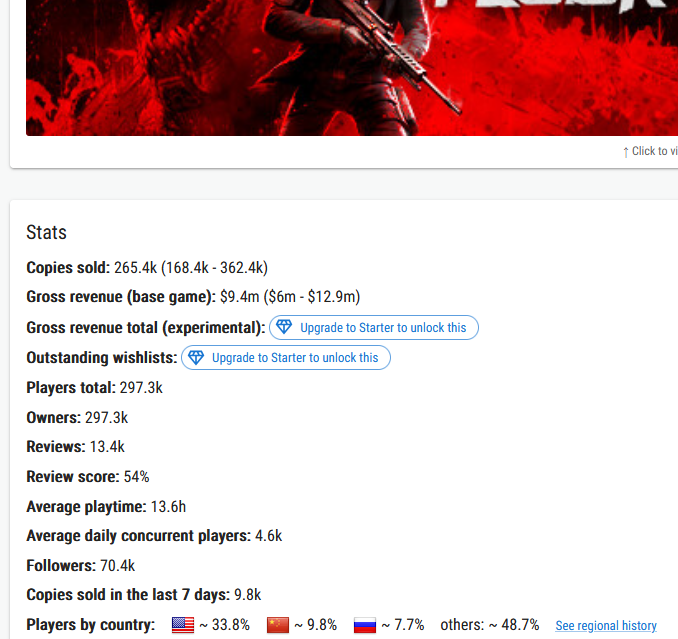
A few important observations:
- ~250K copies sold total on the Steam platform;
- Revenue is about 10M USD 2 weeks in;
- The sales are stagnating as in the last 7 days only ~10K copies were sold, compare to week 1 during which 200K+ copies were sold;
Compare this to this same Gamalytics page right before the release:
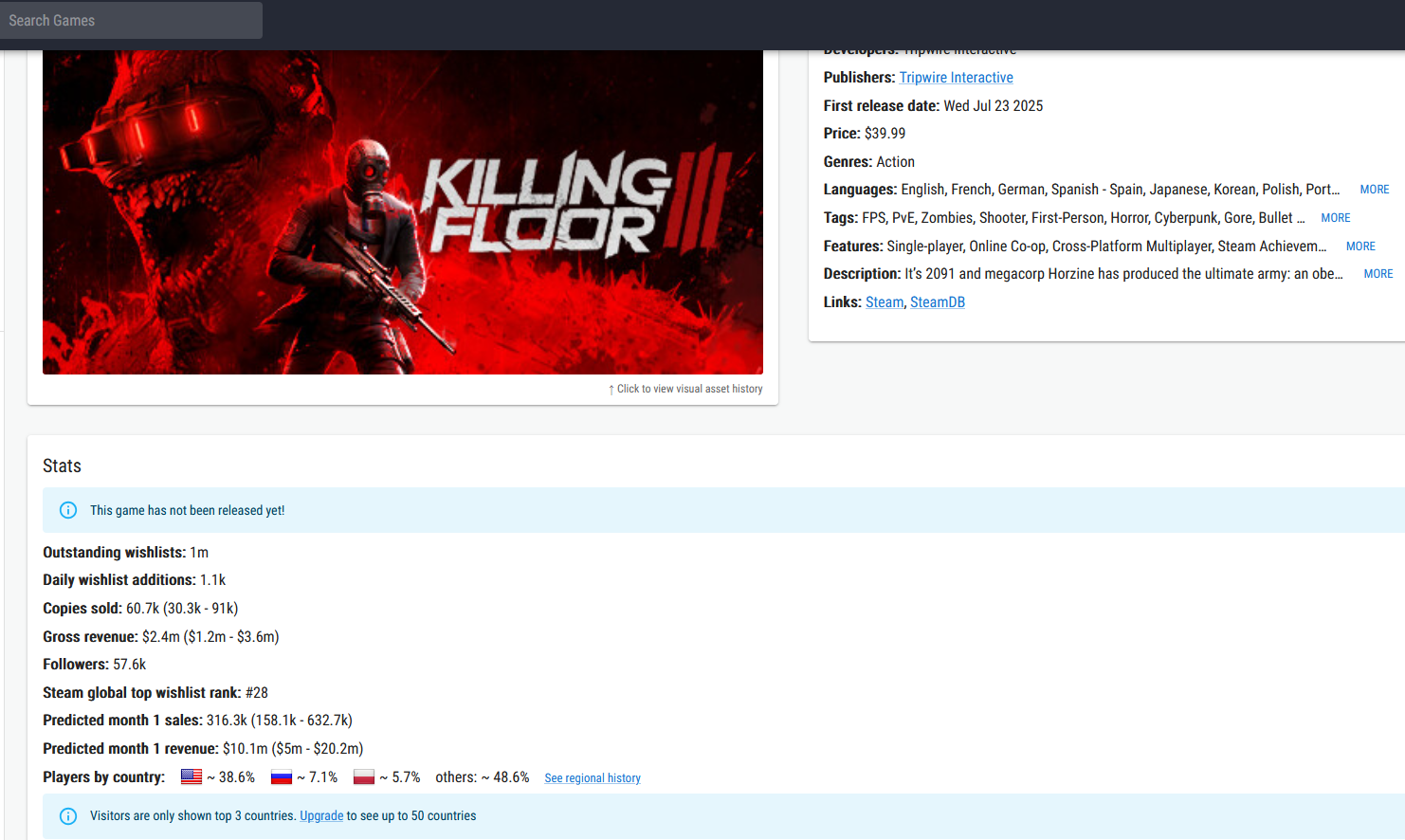
The observations of comparing the two:
- About 60K gamers preordered it, making the preorders to 1 week sales ratio roughly 1:4;
- Kudos to Americans who adjusted their behavior quickly, from ~38% down to ~34%, upon recognizing the actual quality and character of the game, while the Chinese and Russians, instead, doubled down on their buying sprees despite the game’s flaws;
- Even before the release it was clear that the game would flop, as the gamalytic predictions turned out to be pretty close to the post-release sales estimate. Granted, it’s their own estimate, but I doubt they go out of their way to manually adjust the numbers of one particular game to “save the face” so to speak, as they track thousands and don’t have a particular incentive to misrepresent anything. To the contrary, they have a clear incentive to report as accurately as possible, as this is their product and the more accurate it is the better it sells.
Overall, first week sales are a major metric because this is the time when any game is bought the most, right after its release. Shortly after the release the sales go down dramatically until they nigh reach the plateau in a few months after. Overall this dependency resembles well an exponential decay function, with sales on Y and time on X, similar to this pic:
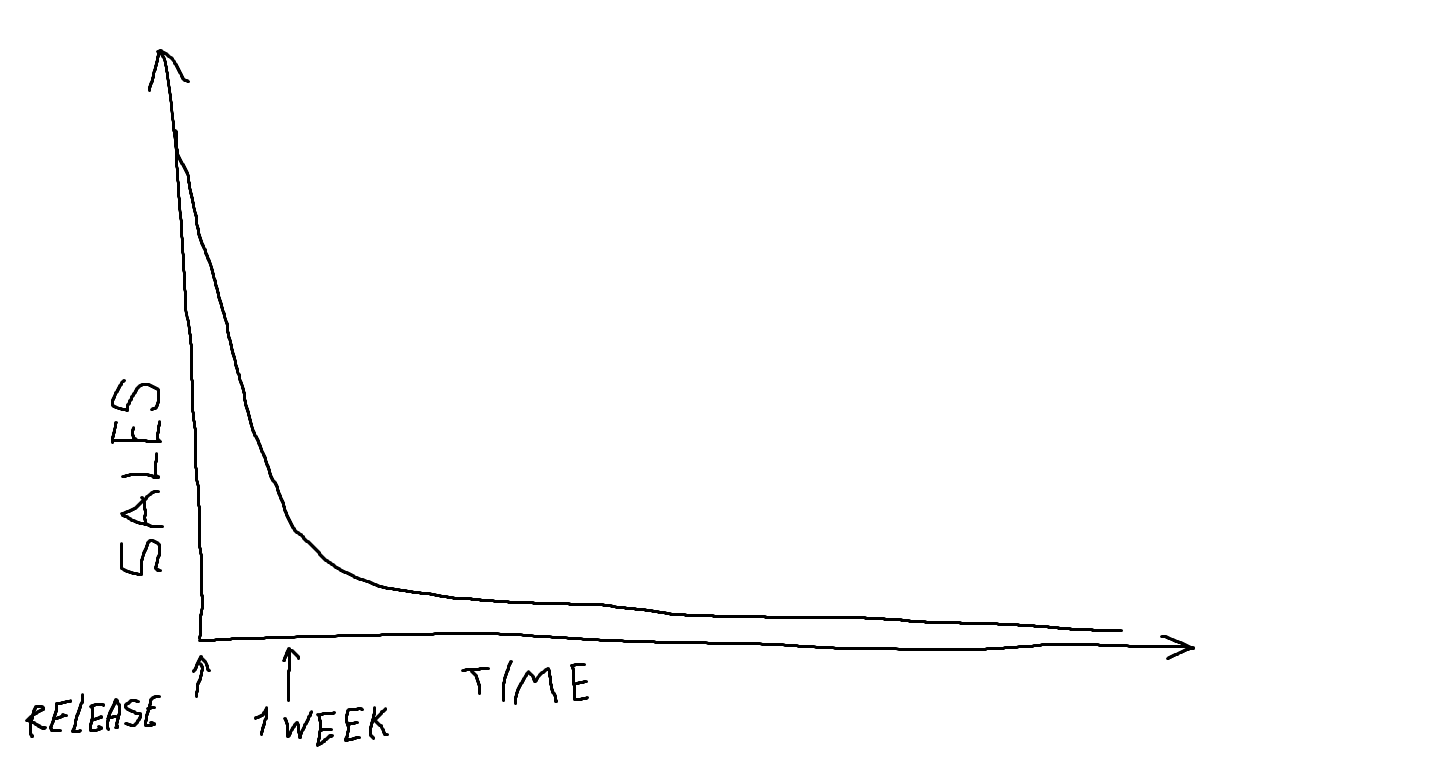 According to this research, 1 week sales for an average Steam game predict roughly x1.5 times more sales over the course of the first month and x4 times more sales over the course of 1 full year. Here’s the same gamalytic page 1 month after release:
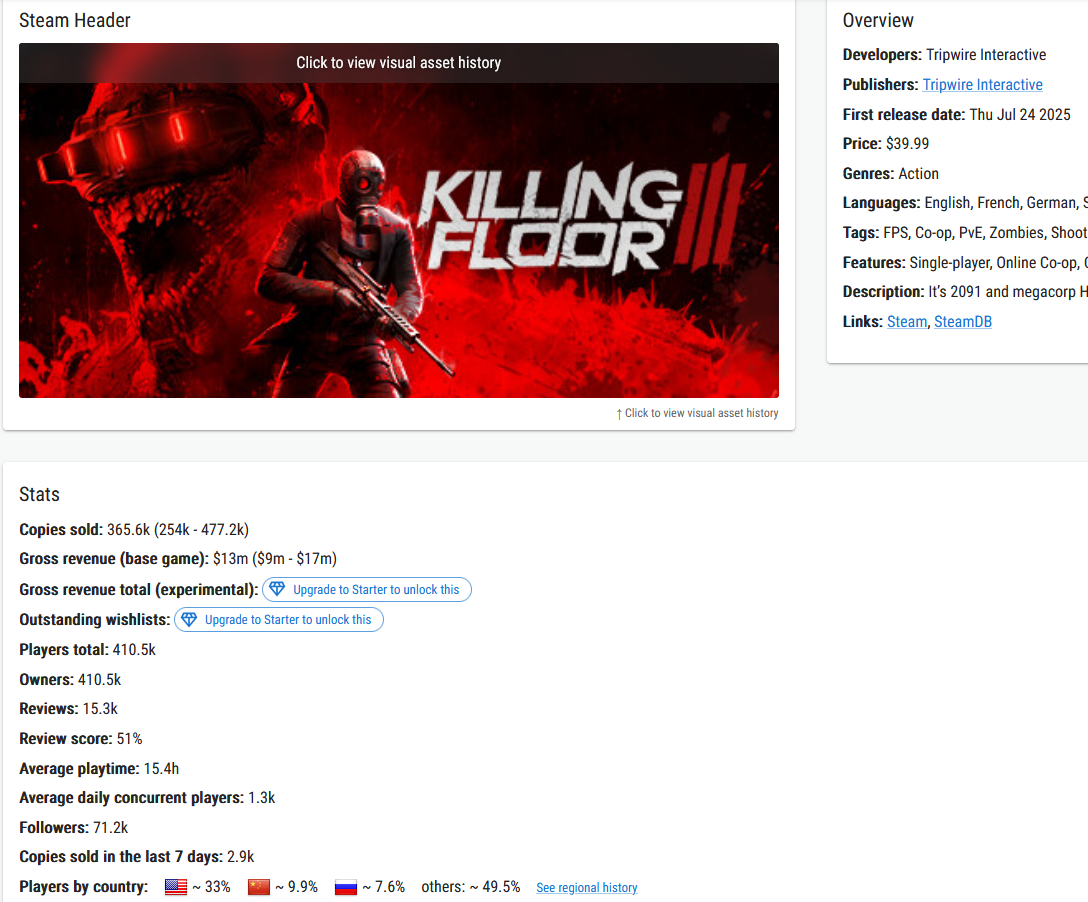
As you can see, by dividing 365 (1 month sales) by 200 (1 week sales) we get roughly 1.8 ratio, which is close enough.
If this heuristic applies to KF3 well, we can expect that they reach about 1M copies sold in 1 year from now on the Steam platform (This phrase was written in August 2025 and overestimates KF3 sales over the course of the first year). Steam is the main platform for PC gaming and I expect that EGS sales are significantly lower than that on Steam. The game also is being sold on Microsoft and Sony gaming consoles. While the console market roughly matches the PC gaming market by total revenue, some games are more console oriented while others are more PC oriented.
In general, precision shooting first person shooters are favored on PC and historically KF games are mostly such shooters. To compare, as of 2025, KF2, which also is sold on the same platforms as KF3, has about ~500 concurrent players averaged on 24 hours base on PC, while both Sony PlayStation and Microsoft Xbox are nearly dead. I would estimate the player base there to be a few hundred concurrent players at most during prime time, dipping to dozen players worldwide during off hours. It’s a struggle to get a team together on specific settings on PS and a struggle to get a team on almost any settings on Xbox. While I agree that TWI wants to cater more to console players with KF3 than they did so with KF2, these things have inertia and I expect that most of their player base still plays it on a PC. I would say, 3:2 of PC to console ratio is plausible (This paragraph was written in August 2025 and now we know that the console players make up the majority of KF3 players, as we can estimate it from the player distribution we see in the actual games, as the player scorecard has icons appropriately for Xbox, PS5 and PC players. This likely is because the game was offered for a prolonged time as a part of PS subscription service, making it “free” for the subscribers).
1 year after the release though the game didn’t align with the Gamalytic predictions, which predicted the total sales number on Steam as 4 times the 1 week sales, which were at 250K copies. Instead, the game sold only ~2 times the predicted number and hovers around ~430K copies sold on Steam. This means that the game performs worse than what follows from analyzing an average Steam game, and through that, performs about 2 times worse than an average Steam game. With all these considerations in mind, given we’ve had ~430K copies sold first year on Steam, about 200K sales on EGS and about 500K sales on all consoles, making totals for 1 year prediction at 430KM (Steam) + 200K (EGS) + 500K (both PS and Xbox consoles) at 1,13M copies sold. With such rough estimates it’s hard to establish any confidence intervals, but they necessarily have to be pretty wide. I would translate 1,13M copies sold roughly to $30M USD, counting the revenue value of each copy to be around $25 USD. This is because of the Steam regional pricing offering the product at lower prices in countries with less GDP per capita than it is in the US, and most of the countries are such, including, notably, Russia, China, South American countries, where the franchise historically been quite popular. As an example, China has about ~10% of the total KF3 copies bought (per Gamalytic) and there the game costs the equivalent of $19.89 USD full non-discounted price. Another contributing factor into the reduced revenue value of the copy is the discount events, of which we have had plenty by now, discounting the game down by -50%, as well as having it free on PS with a yearly bundle subscription.
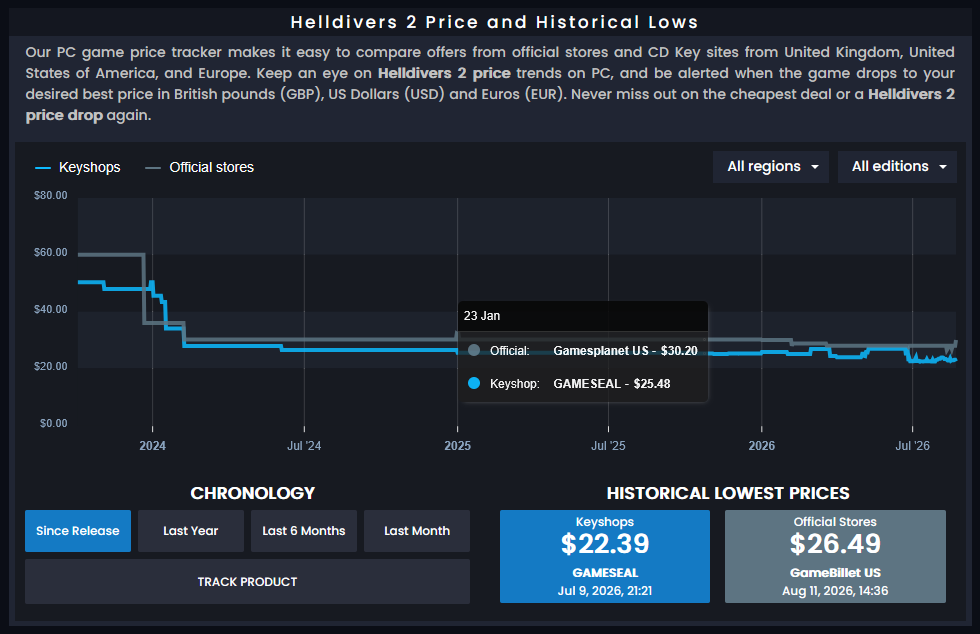
On CD key shops the game is offered with -80% discount, which is rare for games released just 1 year ago and is another marker of failure, as successful games have keys offered at a much smaller discount, here’s an example of a game in a somewhat similar genre, Helldivers 2:
Let me also put this into some context and compare the sales numbers to a few other games in the genre of coop shooters, for now, successful games. The original KF, released in 2009, was a major success that gave a start to this franchise. Sold likely ~7 million copies and was the game that allowed the studio to grow x10 its size during the KF development. This also happened at times when the number of gamers in the world total was roughly twice less than nowadays. This means that if a contemporary game of similar gameplay uplifted to modern standards was released today, one can expect it to sell at least twice more copies. In this paragraph and the next, only Steam copies are counted. The sequel, KF2, released in 2016, likely sold a similar figure of ~7 million copies, according to gamalytic. It was reported in 2019 that the franchise had generated 100+ million dollars for TWI.
A very successful game in this genre, Payday 2, released in 2013, likely sold 30+ million copies. Another very successful game in the same genre, Left 4 Dead 2, released in 2009, likely sold 60+ million copies. A very successful game in this genre, Deep Rock Galactic, released in 2020, likely sold 10+ million copies.
On the other hand, there were a number of unsuccessful games in this genre. The most infamous example worth bringing up is Payday 3, released in 2023, sold likely only ~1.2 million copies on Steam as of August 2026. This is abysmally bad, considering that its predecessor scored roughly 25 times more and likely 10+ time more during the same timeframe of roughly 3 years after the release. It directly resulted in rapidly shrinking revenue for the studio developing it as of recently, as reported in the media, with predictable consequences, such as mass layoffs, higher ups stepping down, etc. In my opinion, KF3 right now follows the steps of Payday 3 and likely to experience similar outcomes down the road.
SKIN SALES
This applies to all downloadable content (DLC) and microtransaction (MTX) sales, the vast majority of which are skins, so for simplicity I call them skin sales. KF3 is too new and has a somewhat different DLC model as so far TWI has been selling skins only. There are no “lootboxes” like in KF2 and no paid weapons yet like in the original KF and KF2. It is very hard to estimate how much TWI has made from skins. If I had to guess, I would say it’s 1/3 of what they have made from the game sales as it pertains to KF2, but it’s a very wild guess. If I had to guess, I’d say that KF3 MTX revenue is even less than that, mainly because there are no paid weapons (yet) and no lootboxes the gambling nature of which should naturally result in higher revenues.
1/3 of the $30M USD (game upfront sales) would be $10M, so we can cautiously estimate total sales to be around $40M USD.
REPUTATIONAL DAMAGE
Good gamer reviews and player retention do not convert directly into revenue, but they contribute to the growth of the intellectual property value over time. Conversely, bad gamer reviews are reputation ruining and contribute to bad sales of the next products of the same gamedev studio, even if it manages to turn the ship around and start selling good games.
If one wanted to browse the opinions and reviews of the early KF3 testers and find a common theme to them, almost universally that would be an impression that the “Killing Floor III” game doesn’t do a good job to maintain the vision that made the first 2 games in a series great with a strong cult fan base. It’s as if “Tripwire Interactive”, the gamedev studio behind the series, intentionally wanted to step aside from the recipe that made the series great and make something new, potentially appealing to a different audience. Some say it’s because this game is being made now by different people or even a different company. Is this right?